
Angola

Our Banknote catalog of Angola.
The kwanza (sign: Kz; ISO 4217 code: AOA) is the currency of Angola. Four different currencies using the name kwanza have circulated since 1977.
HISTORY
Kwanza was introduced following Angolan independence. It replaced the escudo at par and was subdivided into 100 lwei. Its ISO 4217 code was AOK.
On 8 January 1977, banknotes dated 11 DE NOVEMBRO DE 1975 were introduced by the Banco Nacional de Angola (National Bank of Angola) in denominations of 20, 50, 100, 500, and 1000 kwanzas. The 20 kwanza note was replaced by a coin in 1978.
Novo Kwanza, 1990-1995
In 1990, the novo kwanza was introduced, with the ISO 4217 code AON. Although it replaced the kwanza at par, Angolans could only exchange 5% of all old notes for new ones; they had to exchange the rest for government securities. This kwanza suffered from high inflation.
This currency was only issued in note form. The first banknotes issued in 1990 were overprints on earlier notes in denominations of 50 (report not confirmed), 500, 1000 and 5000 novos kwanzas (5000 novos kwanzas overprinted on 100 kwanzas). In 1991, the word novo was dropped from the issue of regular banknotes for 100, 500, 1000, 5000, 10,000, 50,000, 100,000 and 500,000 kwanzas.
Kwanza Reajustado, 1995-1999
In 1995, the kwanza reajustado replaced the previous kwanza at a rate of 1,000 to 1. It had the ISO 4217 code AOR. The inflation continued and no coins were issued.
Despite the exchange rate, such was the low value of the old kwanza that the smallest denomination of banknote issued was 1000 kwanza reajustado. Other notes were 5,000, 10,000, 50,000, 100,000, 500,000, 1,000,000 and 5,000,000 kwanzas.
Second Kwanza, desde 1999
In 1999, a second currency was introduced simply called the kwanza. Unlike the first kwanza, this currency is subdivided into 100 cêntimos. The introduction of this currency saw the reintroduction of coins. Although it suffered early on from high inflation, its value has now stabilized.
The banknotes are quite similar in design, with only different colours separating them.
The Banco National de Angola issued a new series of kwanza banknotes on March 22, 2013 in denominations of 50, 100, 200 and 500 kwanzas. The other denominations (1000, 2000 and 5000 kwanzas) were issued on May 31, 2013.
From Wikipedia
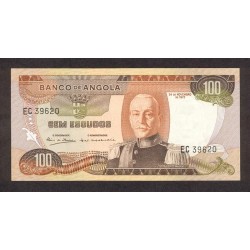
1972 - Angola 100 Escudos banknote P101
This Angola 100 Escudos banknote is identified in the Pick catalogue as P101 and is associated with ..
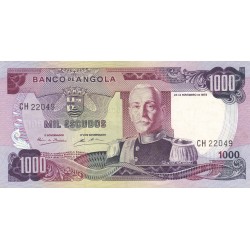
1972 - Angola 1000 Escudos banknote P103
This Angola 1000 Escudos banknote is associated with 24 November 1972 in the Krause catalogue and is..
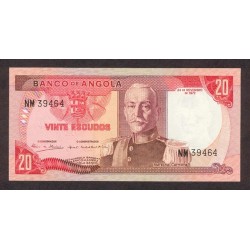
1972 - Angola 20 Escudos banknote P99
This individual banknote is from Angola and has a denomination of 20 Escudos. It is identified in th..
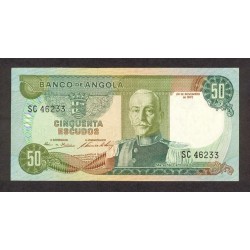
1972 - Angola 50 Escudos banknote PIC 100
Angola 50 Escudos banknote, dated 24 November 1972 in the catalogues and identified as Pick P100. Th..
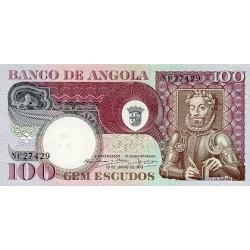
1973 - Angola 100 Escudos banknote P106
Angola 100 Escudos banknote, catalogued as Pick P106 and dated 10 June 1973. This regular-issue note..
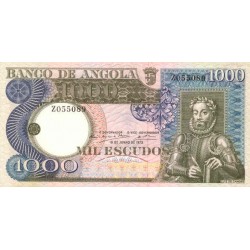
1973 - Angola 1000 Escudos banknote P108
Angola 1000 Escudos banknote dated 10 June 1973, catalogued as Pick P108. The note features an olive..
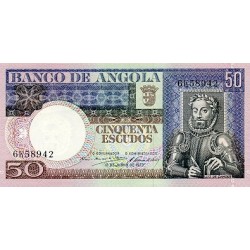
1973 - Angola 50 Escudos banknote P105
Angola 50 Escudos banknote dated 10 June 1973, catalogued as Pick P105. This regular-issue note feat..
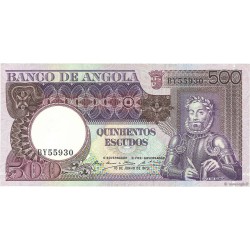
1973 - Angola 500 Escudos banknote P107
Angola 500 Escudos banknote dated 10 June 1973, catalogued as Pick P107. This denomination features ..
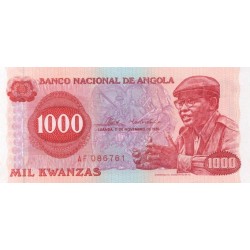
1976 - Angola 1000 Kwanzas banknote P113
Angola 1000 Kwanzas banknote dated 11 November 1976, catalogued as Pick P113. The note features a re..
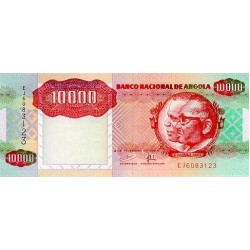
1991 - Angola 10.000 Kwanzas banknote P131b
This individual banknote is from Angola and has a denomination of 10,000 Kwanzas. It is catalogued a..
Frequently asked questions
What periods and currencies are represented in this Angola banknote catalog?
This shop’s Angola catalog spans dated issues from 1972 to 2012, rather than attempting to document every Angolan banknote. It includes escudo notes dated 1972 and 1973, followed by kwanza-denominated issues dated 1976, 1991, 1993, 1995, 1999 and 2012. Collectors can therefore compare several catalog groups and changing denomination formats across the represented periods.
Which denominations and Pick references can collectors find in the Angola category?
The represented escudo denominations include 20, 50, 100, 500 and 1,000 escudos, with references such as P99, P100a, P101a and P103 from 1972, plus P105–P108 from 1973. Kwanza entries range from 10 and 50 kwanzas to high denominations including 10,000, 100,000 and 500,000 kwanzas. Examples include P113, P128b, P128c, P131b, P133x, P134, P135, P138, P140, P145a and P152.
How can I distinguish the illustrated 1972 Angola escudo notes?
Several 1972 notes share arms at left and Marechal Carmona at center right, but their colours and reverse designs differ. P99, the 20-escudo note, is red and brown with flowers on the back. P100a, denominated 50 escudos, is green and brown and depicts Coffea Robusta plants. P101a, the 100-escudo note, uses light and dark brown and shows a tree and plants. These three descriptions also specify a Marechal Carmona watermark.
What is the difference between Angola P128b and P128c?
Both catalog references identify 1991 Angola 500-kwanza notes, but the supplied records distinguish them by signature variety. P128b is listed with Signature 17, while P128c is listed with Signature 18. The catalog also contains listings marked XF for these references. When organizing a collection, record the complete Pick suffix and signature designation rather than identifying the note only by its date and denomination.
What should a buyer check before choosing an Angola banknote listing?
Compare the date, denomination, currency, full Pick reference and any listed variety or grade. Suffixes matter: P128b and P128c correspond to different signature varieties, while P145a and P100a also include catalog suffixes. Some product descriptions state that images are for reference and that the banknote number pictured will not be the number sent. Buyers should therefore use the written listing details, rather than the illustrated serial number, to identify the offered type.
What is notable about the Angola 100,000-kwanza note cataloged as P133x?
The catalog identifies P133x as a 1993 100,000-kwanza “mistake” note with a 10,000 watermark. This mismatch between the printed denomination and the stated watermark is the defining feature recorded for that listing. Collectors examining this type should retain the “x” suffix when cataloging it, because P133x conveys more specific identification than the base number P133 alone. No broader claim about rarity or value is implied by the designation.