
Uganda
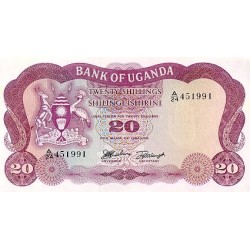
1962 - Uganda 20 Shillings banknote PIC 3 UNC
This Uganda 20 Shillings banknote is associated with 1962 and identified as Pick P3. The catalog ref..
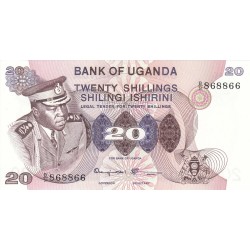
1973 - Uganda 20 Shillings banknote PIC 7c UNC
This Uganda 20 Shillings banknote is associated with 1973 and is identified by the catalogue referen..
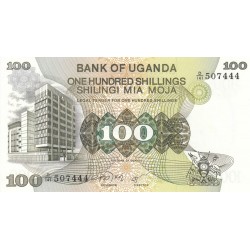
1979 - Uganda 100 Shillins banknote PIC 14b UNC
This individual Uganda 100 Shillings banknote is catalogued as Pick P14b, with 1979 associated with ..
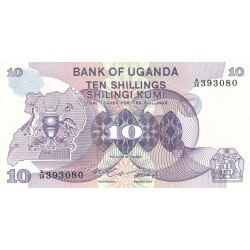
1982 - Uganda 10 Shillins banknote PIC 16 UNC
Uganda 10 Shillings banknote associated with 1982, catalogued as Pick P16. This individual note is d..
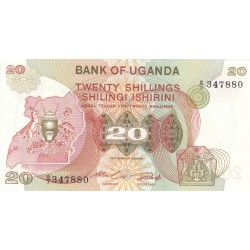
1982 - Uganda 20 Shillins banknote PIC 17 UNC
Uganda 20 Shillings banknote, associated with 1982 and catalogued as Pick P17. This individual bankn..
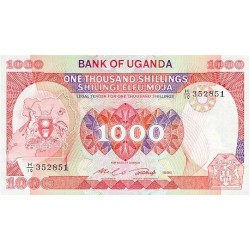
1986 - Uganda 1000 Shillins banknote PIC 26 UNC
This individual Uganda 1,000 Shillings banknote is associated with 1986 and catalogued as Pick P26. ..
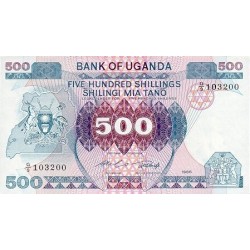
1986 - Uganda 500 Shillins banknote PIC 25 UNC
Uganda 500 Shillings banknote associated with 1986, catalogued as Pick P25. This individual note is ..
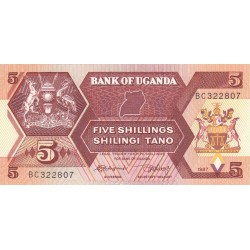
1987 - Uganda 5 Shillins banknote PIC 27 UNC
This Uganda 5 Shillings banknote is associated with 1987 and is catalogued as Pick P27. The note fea..
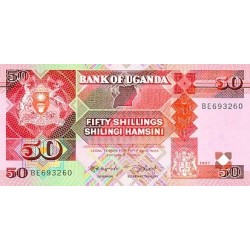
1987 - Uganda 50 Shillins banknote PIC 30a UNC
This individual banknote is a Uganda 50 Shillings note associated with 1987 and identified by the ca..
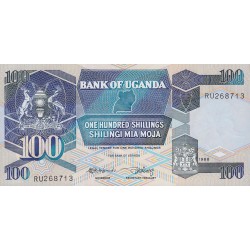
1988 - Uganda 100 Shillins banknote PIC 31b UNC
This Uganda 100 Shillings banknote is catalogued as Pick P31b, with 1988 associated with this varian..
Frequently asked questions
What periods and denominations are represented in this Uganda banknote catalog?
This shop’s Uganda catalog covers dated notes from 1962 through 2010. Represented denominations range from 5 shillings to 10,000 shillings, including 10, 20, 50, 100, 200, 500, 1,000, 2,000 and 5,000 shillings. The selection spans several catalog-reference groups, from P3 and P7c through P49a–P52a. It describes the notes represented by this shop rather than every banknote issued by Uganda.
Which Uganda banknotes from the 2010 series are represented?
The 2010 group represented in the shop’s catalog includes 1,000 shillings P49a, 2,000 shillings P50a, 5,000 shillings P51 and 10,000 shillings P52a. These references form a useful denomination-based group for collectors interested in the later period covered by the category. Because the catalog data identifies each note by year, denomination and reference, those three details should be used together when comparing listings.
How can I identify an Uganda banknote from its catalog listing?
Start with the denomination and stated year, then confirm the catalog reference. For example, the catalog distinguishes a 1962 20-shilling note as P3, a 1973 20-shilling note as P7c and a 1982 20-shilling note as P17. Later 20-shilling listings include 1988 P29b. Using all three fields helps prevent confusion between Uganda notes of the same denomination from different catalog groups.
What do letter suffixes such as “a,” “b” and “c” indicate in these listings?
The letter is part of the catalog reference and should not be omitted when identifying a note. The Uganda category includes examples such as P30a for a 1987 50-shilling note and P30b for a 1989 50-shilling note. It also lists 100-shilling notes as P31b for 1988 and P31c for 1997. Collectors should therefore compare the full reference, not just the base number.
What should a buyer check before choosing an Uganda banknote?
Check the denomination, year, full catalog reference and stated grade in the product title. The supplied Uganda listings are labelled UNC, and their descriptions state that images are for reference, so the banknote number visible in an image should not be treated as the identifying number of the supplied note. For closely related listings, details such as P30a versus P30b or P31b versus P31c are especially important.
Why does P32b appear with more than one year in the Uganda catalog?
The catalog represents P32b as a 200-shilling note dated both 1991 and 1996. This is a useful reminder that a catalog reference may need to be read together with the year shown in the listing. When organizing or selecting Uganda notes, recording only “P32b” would not preserve every detail provided here; noting the denomination and listed year creates a clearer catalog record.