
Australia

Australia banknotes
Our Banknote catalog of Australia.
The Australian dollar (sign: $; code: AUD) is the currency of the Commonwealth of Australia, including Christmas Island, Cocos (Keeling) Islands, and Norfolk Island, as well as the independent Pacific Island states of Kiribati, Nauru and Tuvalu. Within Australia it is almost always abbreviated with the dollar sign ($), with A$ sometimes used to distinguish it from other dollar-denominated currencies. It is subdivided into 100 cents.
As of 2011, the Australian dollar is the 5th most traded currency in the world, accounting for 7.6% of the world's daily share. It trades in the world foreign exchange markets behind the US dollar, the euro, the yen and the pound sterling. The Australian dollar is popular with currency traders, because of the comparatively high interest rates in Australia, the relative freedom of the foreign exchange market from government intervention, the general stability of Australia's economy and political system, and the prevailing view that the Australian dollar offers diversification benefits in a portfolio containing the major world currencies, especially because of its greater exposure to Asian economies and the commodities cycle. The currency is commonly referred to by foreign-exchange traders as the "Aussie".
From Wikipedia
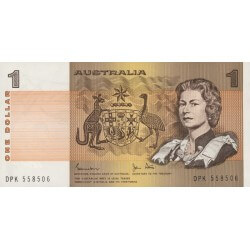
1983 - Australia P42d 1 Dollar banknote
Australia 1 Dollar banknote associated with 1983, catalogued by the shop as P42d and covered by the ..
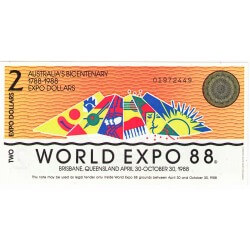
1988 - Australia Expo 88 2 Dollars banknote
This individual banknote is identified as an Australia Expo 88 2 Dollars banknote, with 1988 associa..
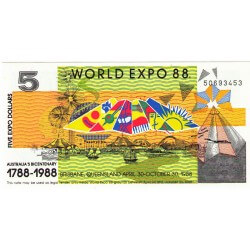
1988 - Australia Expo 88 5 Dollars banknote
Australia Expo 88 5 Dollars banknote associated with 1988. The product is identified as a fantasy, c..
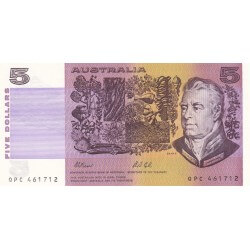
1991 - Australia P44g 5 Dollars banknote
This Australian 5 Dollars banknote is associated with 1991 and catalogued as Pick P44g. The Krause l..
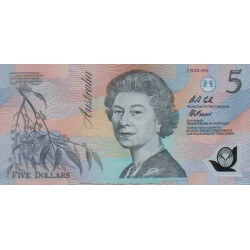
1992 - Australia P50a 5 Dollars banknote
This Australian 5 Dollars banknote is associated with 1992 and catalogued as Pick P50a. The variety ..
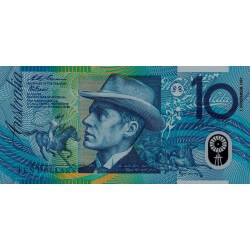
1993 - Australia P52a 10 Dollars banknote
This individual Australian 10 Dollars banknote is associated with 1993 and catalogued as Pick P52a. ..
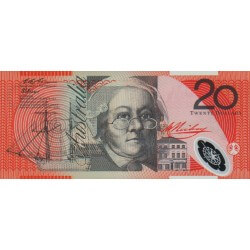
1994 - Australia P53a 20 Dollars banknote
Australia 20 Dollars banknote associated with 1994, catalogued as Pick P53a. This variant belongs to..
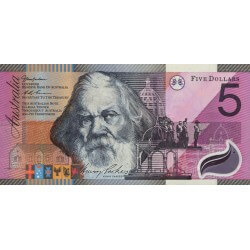
2001 - Australia P56a 5 Dollars polymer banknote
This Australian 5-dollar polymer banknote is associated with 2001 and is catalogued by the shop as A..
Frequently asked questions
What periods and types of Australian banknotes are represented in this shop’s catalog?
The Australia category includes banknotes dated from 1983 to 2001. It covers dollar-denominated notes with standard Pick-referenced listings, as well as Expo 88 commemorative banknotes. The catalog also includes a note explicitly identified as polymer: the 2001 Australia P56a 5 Dollars. This selection describes the periods and types represented by the shop’s records rather than every banknote issued by Australia.
Which Australian denominations and catalog references are represented?
Denominations represented in the Australia catalog include 1 Dollar, 2 Dollars, 5 Dollars, 10 Dollars and 20 Dollars. Listed Pick references include P42d for the 1983 1 Dollar, P44g for the 1991 5 Dollars, P50a for the 1992 5 Dollars, P52a for the 1993 10 Dollars, P53a for the 1994 20 Dollars and P56a for the 2001 polymer 5 Dollars.
How can I identify an Australian banknote using the shop’s listings?
Compare the denomination and date printed or attributed to the note with the product title, then check the Pick reference where one is provided. For example, the catalog distinguishes the 1983 1 Dollar as P42d and the 1994 20 Dollars as P53a. The letter suffix is part of the listed reference, so P44g and P50a should not be treated as interchangeable identifiers.
How are the Expo 88 Australian banknotes identified in this category?
The Expo 88 group is identified by the event name, the 1988 date and denomination rather than by a Pick number in the supplied records. The catalog represents Expo 88 commemorative banknotes in 2 Dollars and 5 Dollars denominations. Collectors comparing these pieces should use the complete title and denomination to distinguish them from the Pick-referenced Australian notes elsewhere in the shop’s catalog.
What details should a buyer compare before choosing an Australian banknote?
A prospective buyer should compare the date, denomination, full catalog reference and any stated material or commemorative designation. For instance, the 2001 5 Dollars is explicitly described as polymer and referenced as P56a, while the 1988 Expo 88 notes are described as commemorative. Because several records share the 5 Dollars denomination, matching only the face value is insufficient; the year and reference or event title also matter.
Why does the 5 Dollars denomination form a notable group in this Australia category?
The 5 Dollars denomination appears across several distinct listings: the 1988 Expo 88 commemorative banknote, P44g dated 1991, P50a dated 1992 and P56a dated 2001. The P56a listing is specifically identified as polymer. This grouping allows collectors to compare different dates, references and catalog descriptions within one denomination, while remaining limited to the examples represented in this shop’s Australia catalog.