
Germany

Our Banknote catalog of Germany.
The Deutsche Mark (German pronunciation: [ˈdɔʏtʃə ˈmaʁk], German mark, abbreviated "DM") was the official currency of West Germany (1948–1990) and unified Germany (1990–2002) until the adoption of the euro in 2002. It is commonly called the "Deutschmark" in English but not in German. Germans often say "Mark" or "D-Mark" . It was first issued under Allied occupation in 1948 replacing the Reichsmark, and served as the Federal Republic of Germany's official currency from its founding the following year until 1999, when the mark was replaced by the euro; its coins and banknotes remained in circulation, defined in terms of euros, until the introduction of euro notes and coins in early 2002. The Deutsche Mark ceased to be legal tender immediately upon the introduction of the euro—in contrast to the other Eurozone nations, where the euro and legacy currency circulated side by side for up to two months. Mark coins and banknotes continued to be accepted as valid forms of payment in Germany until 28 February 2002. However in 2012, it was estimated that as many 13.2 billion marks were in circulation, with polls showing a narrow majority of Germans favouring the currency's restoration.
The Deutsche Bundesbank has guaranteed that all German marks in cash form may be changed into euros indefinitely, and one may do so at any branch of the Bundesbank in Germany. Banknotes can even be sent to the bank by mail.
On 31 December 1998, the Council of the European Union fixed the irrevocable exchange rate, effective 1 January 1999, for German mark to euros as DM 1.95583 = €1.
One Deutsche Mark was divided into 100 Pfennig.
From Wikipedia
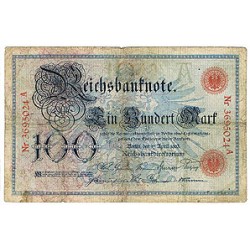
1903 - Germany PIC 22 100 Marks F banknote
This individual banknote is from Germany and has a denomination of 100 Marks. The year 1903 is assoc..
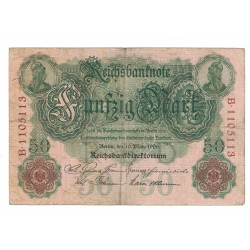
1906 - Germany PIC 26b 50 Marks F banknote
This individual banknote is associated with Germany and has a denomination of 50 Marks. The product ..
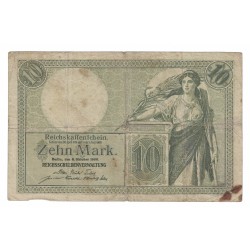
1906 - Germany PIC 9b 10 Marks F banknote
Germany 10 Marks banknote associated with 1906, identified by the Pick 9b catalogue reference. The i..
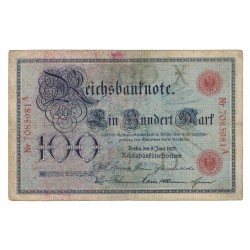
1907 - Germany PIC 30 100 Marks F banknote
Germany 100 Marks banknote associated with 1907, catalogued as Pick (PIC) 30. The denomination is st..
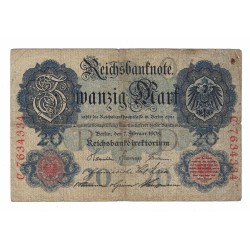
1908 - Germany Pic 31 20 Marks F banknote
Germany 20 Marks banknote associated with 1908, listed under the Pick 31 catalogue reference. The pr..
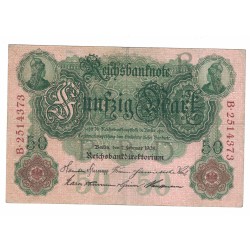
1908 - Germany Pic 32 50 Marks F banknote
This individual banknote is associated with Germany and the year 1908 in the supplied product inform..
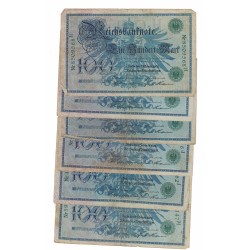
1908 - Germany Pic 34 100 Marks F banknote
This individual banknote is associated with Germany and the year 1908. It has a denomination of 100 ..
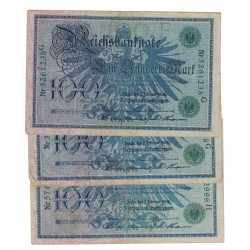
1908 - Germany Pic 34 100 Marks VF banknote
This individual banknote is from Germany and has a denomination of 100 Marks. The product data assoc..
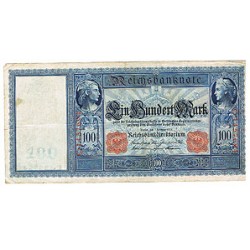
1908 - Germany Pic 35 100 Marks VF banknote
This individual Germany 100 Marks banknote is associated with 1908 and identified by the Pick 35 cat..
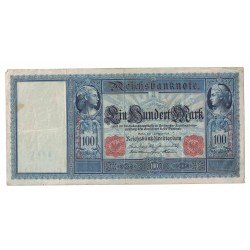
1908 - Germany Pic 35 100 Marks F banknote
Germany 100 Marks banknote, associated with 1908 and identified as Pick 35. The denomination is stat..
Frequently asked questions
What periods and banknote types are represented in the Germany category?
This shop’s Germany catalog represents banknotes dated from 1903 to 1947. The selection includes Marks, Reichsmarks, Rentenmark, Pfennig and occupation-related issues denominated in Kopeken or Rubei. It also includes specimen notes and mixed lots of used German banknotes. These records form a focused catalog selection rather than a complete listing of every banknote issued in Germany.
Which denominations and Pick references stand out in the Germany catalog?
The catalog covers a broad denomination range, from 1 Mark, 2 Marks, 5 Marks and 10 Marks to high-value notes such as 100,000 Marks, 500,000 Marks, 1,000,000 Marks and several million-Mark denominations dated 1923. Other notable references include P72 for 10,000 Marks, P81 for 5,000 Marks, P169 for 5 Rentenmark and P183a/P183b for 100 Reichsmarks.
How can I identify a German banknote using the catalog information?
Compare the note with its stated year, denomination, currency and Pick reference. The catalog includes references such as P46b, P49b, P69a, P72, P83a and P183a, while letter suffixes distinguish references such as P69a and P69b or P183a and P183b. Titles and descriptions may also specify a condition grade, which helps separate otherwise similar listings.
How should collectors compare condition across the German banknotes listed?
The Germany catalog uses grades including G, AG, F, VF, XF and UNC, with some listings also showing intermediate forms such as XF+ or the shop’s equivalent abbreviations. When comparing examples of the same Pick reference, check both the stated grade and the product images. The catalog therefore supports condition-focused collecting, whether comparing circulated and uncirculated examples or building a varied set.
What should I check before buying a German banknote from this catalog?
Review the complete product title and description for the year, denomination, Pick reference and stated grade. Some records specify that images are for reference and that the serial or banknote number shown will not be sent, so the supplied note may not carry that exact number. For mixed lots, the descriptions state that the banknotes correspond with the images; examine those images carefully before ordering.
Does the Germany catalog offer multiple condition choices for the same banknote type?
Yes. Several Pick references are represented in more than one grade, allowing collectors to compare condition within a single type. Examples include P46b 20 Marks, P49b 50 Marks, P69a or P69b 100 Marks, P72 10,000 Marks, P81 5,000 Marks and P83a 100,000 Marks. P169 5 Rentenmark is also shown in VF and XF examples, illustrating the catalog’s range of condition options.