
New Zealand

New Zealand banknotes
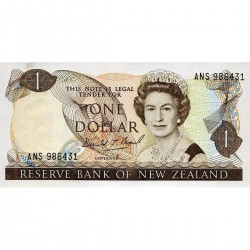
1989/92 - New Zealand PIC 169c 1 Dollar banknote UNC
This New Zealand 1 Dollar banknote is catalogued as Pick P169c and is associated with 1989/92. The n..
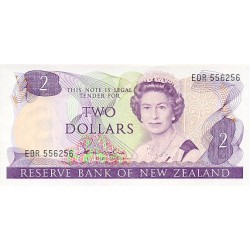
1989/92 - New Zealand PIC 170c 2 Dollars banknote UNC
This New Zealand 2-dollar banknote is catalogued as Pick P170c and is associated with the 1989–92 pe..
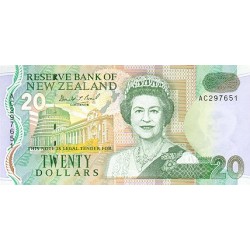
1992 - New Zealand PIC 179a 20 Dollars banknote UNC
New Zealand 20 Dollars banknote associated with 1992 and catalogued as Pick P179a. Listed as an ND (..
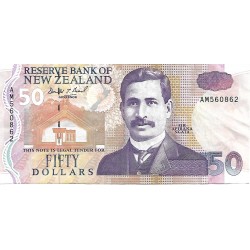
1992 - New Zealand PIC 180a 50 Dollars banknote XF
This New Zealand 50 dollars banknote is associated with 1992 and catalogued as Pick P180a. The indiv..
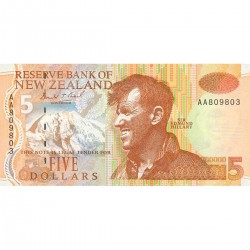
1992/7 - New Zealand PIC 177a 5 Dollars banknote UNC
This individual New Zealand 5 Dollars banknote is catalogued as Pick P177a, the issued-note variety ..

1999 - Chatman (New Zealand) 3 Dollars banknote
This individual banknote is identified as a New Zealand 3 Dollars note associated with 1999. The pro..
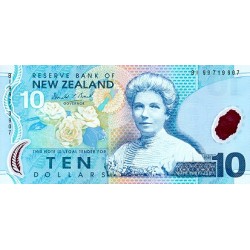
1999 - New Zealand PIC 186b 10 Dollars banknote UNC
This New Zealand 10 Dollars banknote is associated with 1999 and catalogued as Pick P186b. The note ..
Frequently asked questions
Which New Zealand banknote periods and denominations are represented in this shop’s catalog?
The New Zealand selection covers notes dated or issued across the catalog periods 1989/92, 1992, 1992/7 and 1999. Denominations represented include 1, 2, 5, 10, 20 and 50 Dollars, together with a 3 Dollars note identified as Chatman (New Zealand). This is a description of the banknotes represented in this shop’s catalog, rather than a complete listing of every denomination or issue associated with New Zealand.
Which Pick references can be found among the New Zealand banknotes?
The catalog identifies several New Zealand notes by Pick references, including P169c for 1 Dollar, P170c for 2 Dollars, P177a for 5 Dollars, P179a for 20 Dollars, P180a for 50 Dollars and P186b for 10 Dollars. These references are useful for organizing a collection and distinguishing the listed notes by denomination and catalog classification. The 1999 Chatman 3 Dollars note is presented without a Pick reference in the supplied product data.
How can I identify a New Zealand note listed in this catalog?
Begin with the denomination and the period shown in the product title, then compare the Pick reference where one is provided. For example, P169c corresponds to the 1 Dollar note, P170c to 2 Dollars, P177a to 5 Dollars, P179a to 20 Dollars, P180a to 50 Dollars and P186b to 10 Dollars. The catalog also distinguishes the 1999 Chatman 3 Dollars note as a separate named item.
What condition terminology is used for the New Zealand banknotes?
The supplied New Zealand listings use the condition designations UNC and XF. UNC appears with the 1, 2, 5, 10 and 20 Dollar notes, while the 50 Dollar P180a listing is marked XF. These abbreviations describe the catalog’s stated grading terminology; collectors should use the individual product record and photographs or images supplied there to assess the particular note, since the category data does not provide a fuller grading explanation.
What should I check before buying a New Zealand banknote from this category?
Check the individual product record for the denomination, date or period, Pick reference where applicable, and stated condition. This is especially helpful when comparing notes such as P169c, P170c, P177a, P179a, P180a and P186b. The supplied data also notes that the P180a banknote corresponds with the image, so reviewing the product presentation is important. The category description should not be treated as a substitute for the details of a specific listing.
What unusual denomination or special grouping stands out in this New Zealand catalog selection?
Alongside conventional denominations from 1 to 50 Dollars, the catalog includes a 1999 item titled “Chatman (New Zealand) 3 Dollars banknote.” Its 3 Dollars denomination makes it distinct from the other denominations represented in the category data. The selection also includes a consecutive-looking range of standard denominations—1, 2, 5, 10, 20 and 50 Dollars—although the supplied information does not state that these form a complete series or explain the relationship between the issues.