
Eastern Caribbean States

Refine Search
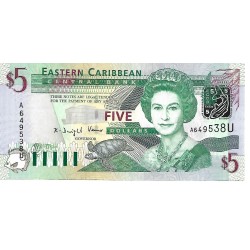
2003 - East Caribbean States PIC 42u 5 Dollars banknote
This individual East Caribbean States 5 Dollars banknote is associated with 2003 in the catalogue an..
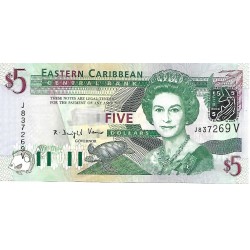
2003 - East Caribbean States PIC 42v 5 Dollars banknote
This individual 5 Dollars banknote from the East Caribbean States is associated with 2003 and is cat..
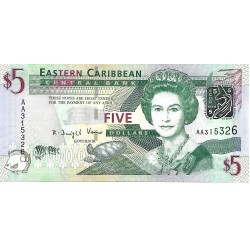
2008 - East Caribbean States PIC 47a 5 Dollars banknote
East Caribbean States 5 Dollars banknote associated with 2008, catalogued as PIC 47a. The note belon..
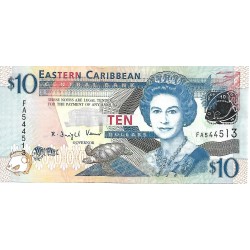
2008 - East Caribbean States PIC 48 10 Dollars banknote
East Caribbean States 10-dollar banknote, catalogued as Pick P48 ND (2008). The note has a blue and ..
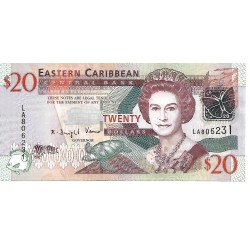
2008 - East Caribbean States PIC 49 20 Dollars banknote
This East Caribbean States 20 Dollars banknote is associated with 2008 and catalogued as Pick P49, d..
Frequently asked questions
What periods and denominations are represented in the Eastern Caribbean States banknote catalog?
The shop’s Eastern Caribbean States catalog includes notes dated from 1965 to 2008. The denominations represented are 5, 10 and 20 dollars. Earlier entries include the 1965 PIC 14h 5-dollar note, while later groups include 2000, 2003 and 2008 issues. This is a selection from the shop’s catalog rather than a complete listing of every Eastern Caribbean States banknote issued.
Which Pick references and banknote groups can collectors find in this category?
The catalog uses Pick references including P14h, P18 variants, P23d1, P26a, P32 variants, P33a, P37 variants, P38 variants, P42 variants, P47a, P48 and P49. Several groups contain lettered or otherwise differentiated variants, especially the 1986/88, 1994, 2000 and 2003 entries. These references provide a useful way to organise the Eastern Caribbean States notes by catalog type, date and denomination.
How can I identify an Eastern Caribbean States banknote in this catalog?
Begin by checking the denomination and date shown in the listing title, then compare the Pick reference. Variant letters and suffixes are important: examples include P18a, P18k, P18m and P18v, as well as P32a and P32v. Some descriptions also identify an associated territory, such as Antigua, St. Vincent, St. Kitts, Montserrat, Dominica, or Anguilla. Use all these details together when distinguishing similar notes.
What should I record when building a collection of these banknotes?
For each Eastern Caribbean States note, record its date or date range, denomination, Pick reference and any territorial designation included in the catalog description. It is also useful to preserve the exact variant marking, such as P37d2, P37k2 or P42u. Condition wording can be recorded separately; several listings explicitly use “UNC,” while other listings do not include that designation. Keeping these details together helps maintain consistent collection records.
What should I check before buying an Eastern Caribbean States banknote from the shop?
Before buying, compare the listing’s title and description with the note you want: check the denomination, date or date range, Pick reference, variant marking and any named territory. Pay particular attention to similar entries, such as the different P18 and P37 variants. Where a listing states “UNC,” treat that as the cataloged condition description for that item. Product details should be reviewed individually, since catalog records differ in the information they provide.
Why do the 2000 and 2003 Eastern Caribbean States entries show several territory-linked variants?
A notable catalog pattern is the range of territory-linked variants within the 2000 and 2003 groups. The 2000 listings include P37 examples associated with Antigua, Dominica, St. Kitts and Montserrat, plus P38 examples for St. Kitts and Montserrat. The 2003 group includes P42 entries linked with Antigua, St. Kitts, Montserrat, Anguilla and St. Vincent. These designations are useful comparison points when organising related notes.