
Ecuador

Our catalogue of banknotes of Ecuador.
The sucre was the currency of Ecuador between 1884 and 2000. Its ISO code was ECS and it was subdivided into 10 decimos or 100 centavos. The sucre was named after Antonio José de Sucre.
Source: Wikipedia
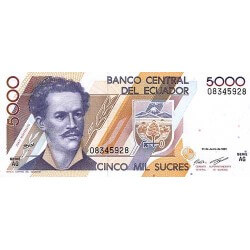
1999 - Ecuador PIC 128c 5,000 Sucres banknote UNC
Ecuador 5,000 Sucres banknote associated with 1999, catalogued as Pick P128c. This individual note i..
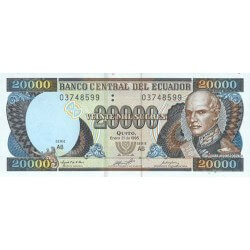
1999 - Ecuador PIC 129f 20,000 Sucres banknote UNC
This individual Ecuador banknote is denominated at 20,000 Sucres and is associated with the year 199..
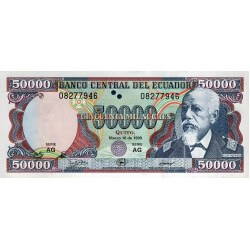
1999 - Ecuador PIC 130c 50,000 Sucres banknote UNC
Ecuador 50,000 Sucres banknote associated with 1999. The note is identified by the catalog reference..
Frequently asked questions
What periods and denominations are represented in the Ecuador banknote catalogue?
This shop’s Ecuador catalogue focuses on sucre-denominated notes from 1938 through 1999. The represented denominations range from 1, 5, 10, 20, 50 and 100 sucres to 500, 1,000, 5,000, 10,000, 20,000 and 50,000 sucres. The catalogue therefore includes both lower- and higher-denomination issues from the later decades of the sucre currency, rather than presenting a complete list of every Ecuadorian banknote.
Which Pick references and note groups can collectors find for Ecuador?
The catalogue includes a broad selection of Pick references, including P84b, P108b, P113d, P114b, P115b, P121a and related variants, P122, P123 and its lettered variants, P124A, P125a–b, P127a and P127e, P128c, P129a and P129f, and P130a and P130c. These references cover denominations from 5 sucres through 50,000 sucres and provide a useful framework for organising Ecuadorian sucre notes by type and variant.
How can I identify an Ecuador banknote listed in this catalogue?
Start by matching the denomination, year and Pick reference shown in the listing. Letter suffixes are important: for example, the catalogue distinguishes P125a from P125b, P127a from P127e, and several P123 variants. Some listings also identify a month or day, such as P123Ab dated March or December 1992. Compare these details with the printed features on the note rather than relying on denomination alone.
What should I check when comparing variants of Ecuadorian sucre notes?
Check the full reference, year, denomination and any date detail together. The catalogue contains several 100-sucres listings under P123Ab, including March and December 1992 examples, as well as 1993, 1994 and 1997 P123 variants. It also shows different references for 1,000-, 10,000-, 20,000- and 50,000-sucres notes. These identifiers help separate visually similar notes and keep a collection accurately organised.
What should a prospective buyer review before choosing an Ecuador banknote?
Review the listing title and model reference carefully, paying particular attention to the denomination, year, suffix and any stated date. Condition information also matters: many Ecuador listings are marked UNC, while some do not include that designation in the title. If comparing similar notes, use the Pick reference and variant details first, then examine the product photographs and description supplied with the individual listing.
Are there notable date and denomination patterns in the Ecuador catalogue?
A notable pattern is the concentration of late-1980s and 1990s sucre notes, including multiple variants of the 100-sucres P123 family. The catalogue also shows the denomination scale rising from 5 sucres in earlier listings to 50,000 sucres in 1999. Within the higher denominations, examples include 10,000 sucres dated 1994 and 1998, and 20,000 sucres dated 1995 and 1999.