
Haiti

The gourde (French: [ɡuʁd]) or goud (Haitian Creole: [ɡud]) is the currency of Haiti. Its ISO 4217 code is HTG and it is divided into 100 centimes (French) or santim (Creole).
Source: WikIpedia
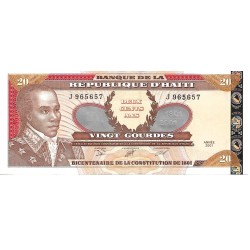
2001 - Haiti P271 20 Gourdes banknote UNC
Haiti 20 Gourdes banknote associated with 2001, catalogued as Pick P271. The note features a brown, ..
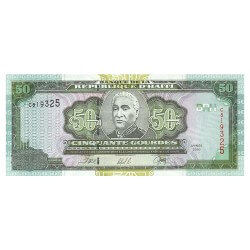
2003 - Haiti P267b 50 Gourdes banknote UNC
Haiti 50 Gourdes banknote associated with 2003, catalogued as P267b and corresponding to the Krause ..
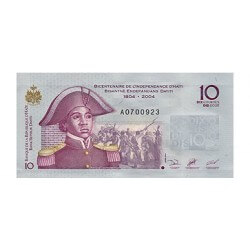
2004 - Haiti P272a 10 Gourdes banknote UNC
This individual Haiti 10 Gourdes banknote is associated with 2004 and is catalogued as Pick P272a. T..
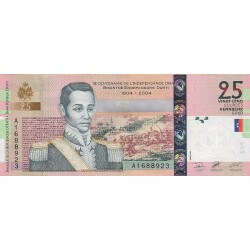
2004 - Haiti P273 25 Gourdes banknote UNC
This Haiti 25 Gourdes banknote is associated with 2004 and is catalogued as Pick P273. The individua..
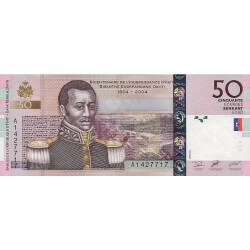
2004 - Haiti P274a 50 Gourdes banknote UNC
Haiti 50 Gourdes banknote associated with 2004, catalogued as Pick P274a. This individual note is gr..
2014 - Haiti P272g 10 Gourdes banknote UNC
This Haiti 10 Gourdes banknote is catalogued as PIC 272g and is associated with 2014. It is listed i..
Frequently asked questions
What periods and denominations are represented in the Haiti banknote category?
The Haiti catalog covers banknotes dated from 1984 to 2014. Denominations represented are 1, 2, 10, 20, 25 and 50 gourdes. The selection includes notes from the 1980s, 1990s, 2000s and 2010s, providing several period and denomination groupings for collectors. This FAQ describes the notes represented in this shop’s catalog, rather than every banknote issued by Haiti.
Which Pick references can be found among the Haiti banknotes?
The catalog includes Pick references P239, P253, P254a, P256a, P257, P259a, P260, P262, P265a, P266a, P267b, P271, P272a, P272g, P273 and P274a. These references cover the listed Haitian gourde denominations and dates. Pick numbers are useful for organizing a collection and distinguishing cataloged types, while suffixes such as “a,” “b” and “g” should be recorded as part of the reference.
How can I identify a Haiti banknote using the information shown in the catalog?
Begin with the denomination and date printed in the product title, then compare the Pick reference. For example, the category lists 10-gourdes notes as P256a, P265a, P272a and P272g, associated with different dates. A complete identification record can therefore include country, denomination, year, Pick reference and the condition notation shown by the shop. This approach helps separate similar entries without relying on appearance alone.
How can collectors organize these Haiti banknotes?
A practical arrangement is by denomination, followed by date and Pick reference. The catalog supports groups such as 1-gourde notes from 1984, 1989 and 1992; 2-gourdes notes from 1990 and 1992; and 10-gourdes notes from 1991, 2000, 2004 and 2014. Collectors can also keep suffix variants together, such as P272a and P272g, while retaining each note’s individual catalog reference.
What should I check before buying a Haiti banknote from this category?
Check that the denomination, year and Pick reference match the note you want, especially where one denomination appears in several cataloged types. Review the product title for the condition designation “UNC,” and compare suffixes such as P254a, P265a or P267b carefully. It is also helpful to confirm that the listing corresponds to your collecting plan, whether organized by period, denomination, reference or variant.
Which denomination shows the broadest range of dated entries in this Haiti catalog?
The 10-gourdes denomination has a particularly broad spread of dated entries in the catalog: P256a from 1991, P265a from 2000, P272a from 2004 and P272g from 2014. This makes it a useful denomination for a date-and-reference sequence. The entries also demonstrate why both the year and the full Pick suffix matter when distinguishing cataloged Haitian banknotes.