
Suriname

The dollar replaced the Surinamese guilder on 1 January 2004, with one dollar equal to 1000 guilders. Initially, only coins were available, with banknotes delayed until mid-February, reportedly due to a problem at the printer, the Bank of Canada.
The Surinamese dollar replaced the Surinamese guilder on 1 January 2004, with one dollar equal to 1,000 guilders, prompting the issuance of notes denominated in the new currency. On the notes, the currency is expressed in the singular, as is the Dutch custom.
Source: Wikipedia
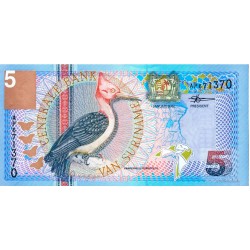
2000 - Suriname 5 Gulden banknote PIC 146 UNC
This Suriname 5 Gulden banknote is associated with 1 January 2000 and is catalogued as Pick P146. It..
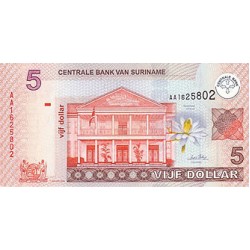
2000 - Suriname 5 Gulden banknote PIC 157 UNC
This individual banknote from Suriname is identified in the product listing as a 5 Gulden note assoc..
Frequently asked questions
Which periods and denominations of Suriname banknotes are represented in the shop’s catalog?
The Suriname catalog covers banknotes dated from 1963 to 2000. The denominations represented are 2 1/2, 5, 10, 25, 100 and 1,000 gulden. These entries include notes from the 1960s, 1980s, 1990s and 2000, providing a cross-section of guilder-denominated issues listed by the shop. This selection describes the shop’s catalog and is not a complete list of every banknote issued by Suriname.
Which Pick references and note variants can collectors find in the Suriname category?
The catalog includes Pick references from P119 through P157, with several lettered variants. Examples include P120b, P121b, P127b, P128b, P132b, P136a, P137a and P137b, as well as P138a, P138d, P139a and P139b. The suffix letters are useful for distinguishing catalogued variants that may share a denomination or related design series. Always use the complete Pick reference when recording a note.
How can I identify a Suriname banknote listed in this catalog?
Begin by checking the denomination and date printed or catalogued for the note, then compare them with the shop title and Pick reference. The lettered suffix is also important: for example, P137a and P137b are separate references, as are P139a and P139b. Combining the country, year, denomination and full Pick designation provides a clearer identification than relying on denomination alone.
What does the UNC notation indicate in the Suriname listings?
The Suriname product titles use the abbreviation “UNC” as their condition notation. Collectors should retain that notation when organising catalog records and distinguish it from the note’s denomination, date and Pick reference. For accurate identification, consider all of these details together rather than treating the condition notation as a substitute for the catalog reference. The FAQ describes the way these notes are labelled in the shop’s catalog.
What should I check when selecting a Suriname banknote from the catalog?
Check the denomination, date, full Pick reference and any lettered variant suffix before making a selection. This is especially helpful for related entries such as P137a and P137b or P138a and P138d. The product title also identifies the listed condition as UNC. Comparing these details with the product information helps ensure that the catalogued note matches the type you want to add to your collection.
What denomination pattern appears among the Suriname notes dated 2000?
The 2000-dated Suriname entries cover a broad range of guilder denominations: 5, 10, 25, 100 and 1,000 gulden. The catalog also includes another 2000 5-gulden reference, P157, alongside P146. This makes the 2000 group notable for combining lower and higher denominations while also showing that the same denomination can occur under more than one Pick reference.