
Hungary
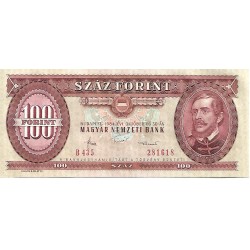
1984 - Hungary PIC 171g 100 Forint banknote UNC
This Hungary 100 Forint banknote is catalogued as Pick P171g and is associated with the 30 October 1..
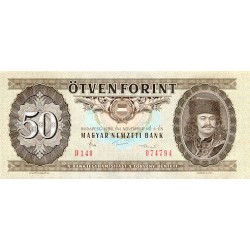
1986 - Hungary PIC 170g 50 Forint banknote UNC
This Hungary 50 Forint banknote is associated with 1986 and is catalogued as Pick P170g. The note fe..
1989 - Hungary PIC 170h 50 Forint banknote UNC
This Hungarian 50 Forint banknote is catalogued as Pick P170h and carries the date association 10 Ja..
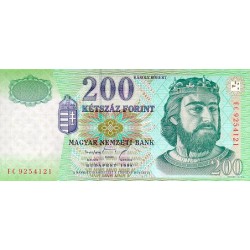
1998 - Hungary PIC 178 200 Forint banknote UNC
This Hungarian 200 Forint banknote is associated with 1998 and catalogued as Pick P178. The individu..
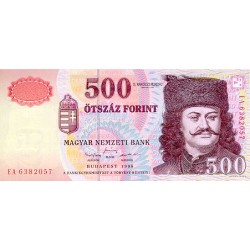
1998 - Hungary PIC 179 500 Forint banknote UNC
This Hungary 500 Forint banknote is associated with 1998 and catalogued as Pick P179. It is presente..
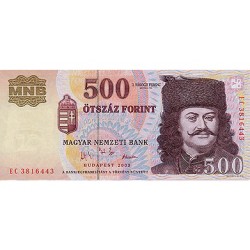
2001 - Hungary PIC 188 500 Forint banknote UNC
This Hungarian 500 Forint banknote is associated with 2001 and catalogued as Pick P188. Listed in UN..
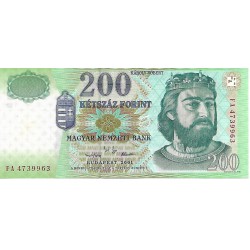
2001 - Hungria PIC 187a 200 Forint banknote UNC
This Hungary 200 Forint banknote corresponds to the 2001 variant of Pick reference P187a. Catalogued..
Frequently asked questions
What periods and currencies are represented in this Hungary banknote category?
This shop’s Hungary catalog spans dated examples from 1930 to 2001. The earlier listings include Pengo notes from 1930, 1932 and 1946, while later entries use the Forint and range from 1962 through 2001. The selection therefore supports collecting across several decades and two named currencies. It represents the notes recorded in this shop’s catalog rather than a complete survey of every banknote issued by Hungary.
Which Hungary banknote denominations appear in the catalog?
The catalog includes Forint denominations of 10, 50, 100, 200 and 500. Pengo listings include 50 and 100 Pengo, together with high-denomination 1946 notes titled 1 Million, 10 Million and 100 Million Pengo, plus 1 Milliard Pengo. Pick references run across groups such as P98–P99, P128–P131, P168, P170–P171 and P178–P188, providing several possible ways to structure a Hungary collection.
How can I distinguish the dated variants of Hungary P168 and P170?
Use the complete Pick reference and date rather than denomination alone. The 10 Forint notes are listed as P168c dated 1962, P168d dated 1969 and P168e dated 1975. The 50 Forint group includes P170f dated 1983, P170g dated 1986 and P170h dated 1989. These suffix letters identify catalog variants within the same main Pick number, making them important when comparing similar Hungary banknotes or recording a collection accurately.
How can collectors organize the Hungary notes represented here?
A practical approach is to arrange the notes first by currency—Pengo and Forint—then by Pick number, suffix and date. Denomination can provide a second structure, especially for the 10 Forint P168 variants and 50 Forint P170 variants. Grade should also be recorded separately: the product titles include UNC examples and an XF example of the 1930 P98 100 Pengo. This prevents notes sharing the same reference from being treated as identical in a collection record.
What details should a buyer check when considering a Hungary banknote listing?
Check the denomination, printed year stated in the title, full Pick reference and grade designation. Variant suffixes matter: P168c, P168d and P168e are separate catalog listings, as are P170f, P170g and P170h. Buyers should also distinguish similarly denominated notes from different years, such as the 200 and 500 Forint listings dated 1998 and 2001. Review the individual product information and images for the specific note rather than relying only on the category overview.
What is notable about the 1946 Pengo group in this Hungary catalog?
The 1946 group forms a clear denomination and reference sequence. It includes P128 at 1 Million Pengo, P129 at 10 Million Pengo, P130 at 100 Million, and P131 at 1 Milliard Pengo. This progression makes the group useful for collectors interested in consecutive Pick references or sharply increasing written denominations. The catalog data identifies these notes by year, denomination and reference, without providing print-run, scarcity or historical-circulation details.