
Italy
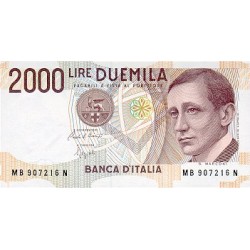
1990 - Italy PIC 115 2.000 Liras banknote UNC
This Italian 2,000 Lire banknote is associated with 1990 and catalogued as Pick P115. Listed in unci..
Frequently asked questions
What periods and denominations are represented in this Italy banknote category?
This shop’s Italy catalog represents lira banknotes dated from 1962 through 1990. Listed denominations include 500, 1,000, 2,000, 5,000 and 10,000 lire. The selection is therefore focused on specific Italian issues from the latter half of the twentieth century rather than every banknote issued by Italy. Dates, denominations and Pick references shown in individual listings provide the clearest guide to the scope of the category.
Which Pick catalog groups appear among the Italian banknotes?
The Italy category includes references from P94 through P115, with several related variants. Examples include P94 and P95 for 500 lire; P109 and P114 for 1,000 lire; P103 and P115 for 2,000 lire; P105 and P111 for 5,000 lire; and P97, P106 and P112 for 10,000 lire. This grouping describes the shop’s catalog only and should not be read as a complete list of Italian Pick references.
How can I distinguish Italian banknotes with the same denomination?
Use the printed denomination together with the stated date and Pick reference. The catalog contains, for example, several 10,000-lire groups identified as P97, P106 and P112, while 1,000-lire notes include P109 and P114. Notes sharing a denomination may therefore belong to different catalog types. When comparing listings, match all three identifying details rather than relying on the denomination alone, and check any suffix attached to the Pick number.
What do suffixes such as “a,” “b” and “c” mean in these listings?
A suffix forms part of the Pick reference and identifies the cataloged variant stated for that note. The Italy catalog includes examples such as P105a and P105b, P106a and P106b, P109a and P109b, P112a and P112b, and P114a and P114c. Buyers and collectors should preserve the full reference when recording a note, because shortening P114c to P114 would omit variant-level identification supported by the listing.
What details should a buyer compare before choosing an Italy banknote?
Compare the denomination, stated date, complete Pick reference and advertised grade. Grades represented in this Italy catalog include UNC, XF, VF and F, and some model fields also use the corresponding abbreviations EBC, MBC and BC. Notes with the same denomination or Pick family may differ by date, suffix or condition. Review the individual product record carefully so that the identification and grade match the type of Italian lira note you want.
Why does the same Italian Pick reference sometimes appear with different dates or grades?
The catalog shows that one reference can be represented by more than one dated or graded listing. P94 appears with 1974 and 1979 dates, while P95 dated 1976 is represented in UNC and VF. P106a appears with 1976 and 1978 dates, and P112a dated 1984 appears in UNC and XF. These distinctions are useful when organizing a collection: record the full Pick reference, date and grade rather than treating every listing under one reference as identical.