
Afghanistan

Afghanistan banknotes
Our Banknote catalog of Afghanistan.
The Afghani (sign: Afs; Pashto: افغانۍ; Dari افغانی; code: AFN) is the currency of Afghanistan. It is nominally subdivided into 100 pul (پول), although there are no pul coins currently in circulation.
Historia:
Between 1925 and 1928, Treasury notes were introduced in denominations of 5, 10 and 50 Afghanis. In 1936, 2, 20 and 100 Afghani notes were added. The Bank of Afghanistan took over paper money production in 1939, issuing notes for 2, 5, 10, 20, 50, 100, 500 and 1000 Afghanis. The 2 and 5 Afghani notes were replaced by coins in 1958. In 1993, 5000 and 10,000 Afghani notes were introduced.
"A 'pothole cave' or 'mouth of a shaft' (or Pit cave) is said to be visible on the 10,000 Afghanis banknote as a limited dark area in the hillside above the ancient 'pol' or gateway at the ruins near Lashkar Gah. This is possibly the entrance to one of the man-made undergrounds at Qal'a-i-Bost."
New Afganí 2002-
Between October 7, 2002, and January 2, 2003, a new Afghani was introduced with the ISO 4217 code AFN. No subdivisions have been issued. It replaced the previous Afghani at two distinct rates. Issues of the government of President Burhanuddin Rabbani were replaced at a rate of 1000 to the new Afghani, whilst the issues of Abdul Rashid Dostum (the Northern Alliance) were replaced at a rate of 2000 to the new Afghani, The new Afghani was valued at 43 Afghani to the U.S. dollar. Prior to the reissue, there were more than 15 trillion Afghani in circulation after unrestrained printing under Taliban rule and during wars and occupation.
In October 2003, Afghan Central Bank governor Anwar Ul-Haq Ahadi announced that Afghans should use their own Afghani currency in daily transactions rather than United States dollars or Pakistani rupees. This was in preparation for October 8 when all prices in the Afghan marketplace were to be specified in Afghani.
After depreciating during the last quarter of 2003/04, the Afghani has been appreciating steadily, gaining 8 percent against the U.S. dollar between end-March 2004 and end-July 2004. This appreciation, at a time of increasing inflation, appears to reflect a greater willingness by the population to use the Afghani as a medium of exchange and as a store of value. This trend appears to be attributable to the relative stability of the exchange rate since the introduction of the new currency, administrative measures aimed at promoting its use, such as the requirement that shopkeepers must price goods in Afghani. Donors are increasingly making payments in Afghani instead of U.S. dollars and this appears to be widely accepted.
From Wikipedia
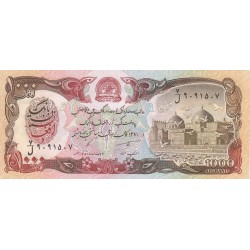
1993 - Afganistan Pic 63 10000 Afghanis banknote
This Afghanistan banknote is a 10,000 Afghanis denomination, catalogued as Pick P63 and associated w..
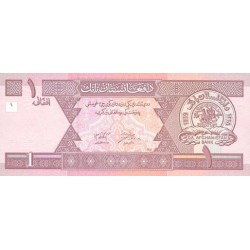
2002 - Afganistan Pic 64a 1 Afghani banknote
This Afghanistan 1 Afghani banknote is associated with 2002 and is identified by the specific Pick r..
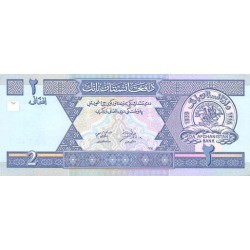
2002 - Afganistan Pic 65a 2 Afghanis banknote
This Afghanistan banknote is a 2 Afghanis denomination associated with 2002 and identified in the pr..
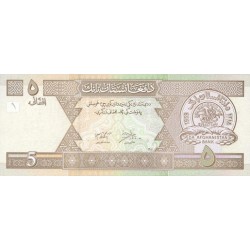
2002 - Afganistan Pic 66a 5 Afghanis banknote
This individual banknote from Afghanistan has a denomination of 5 Afghanis and is associated with 20..
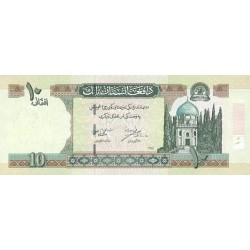
2002 - Afganistan Pic 67a 10 Afghanis banknote
This Afghanistan banknote is a 10 Afghanis denomination associated with 2002 and catalogued as Pick ..
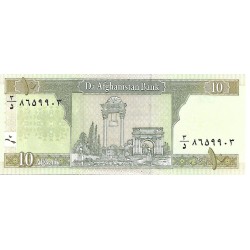
2004 - Afganistan 10 Afghanis banknote PIC 67b UNC
Afghanistan 10 Afghanis banknote associated with 2004, catalogued as PIC 67b. The note is listed in ..
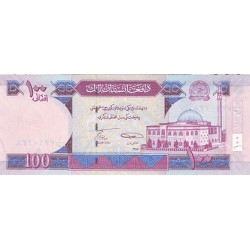
2008 - Afganistan Pic 75a 100 Afghanis banknote
This individual banknote is from Afghanistan and has a denomination of 100 Afghanis. It is associate..
Frequently asked questions
What periods of Afghanistan banknotes are represented in this shop’s catalog?
The Afghanistan category spans issues dated from 1967 through 2008. Represented groups include 1967, 1973 and 1973/5, 1977, 1979, 1990–1993, 2002, 2004 and 2008. All listed examples are identified as regular issues. This range provides material from several distinct catalog sequences, but it should be understood as a description of this shop’s catalog rather than a complete record of every Afghanistan banknote issue.
Which Afghani denominations can be found in the catalog?
Denominations represented in this Afghanistan category range from 1 Afghani to 10,000 Afghanis. They include 1, 2, 5, 10, 20, 50, 100, 500, 1,000, 5,000 and 10,000 Afghanis. Some denominations appear in more than one issue series or Pick variety, such as the 10, 50, 100, 500 and 1,000 Afghani notes. The selection reflects the shop’s catalog and not every denomination or type issued for Afghanistan.
How can I distinguish similar Afghanistan banknotes using Pick references?
Use the complete Pick reference together with the denomination and issue date. A suffix can distinguish cataloged variants sharing the same main number. Examples include P47a and P47c for 10 Afghanis, P57a and P57b for 50 Afghanis, P58a, P58b and P58c for 100 Afghanis, and P60a, P60b and P60c for 500 Afghanis. Because the catalog data does not specify every visual difference, collectors should avoid identifying a variant from denomination alone.
What are some practical ways to organize an Afghanistan banknote collection from this category?
Collectors can organize these Afghanistan notes by issue series, denomination or Pick-number progression. One approach is to group the 1973–1977 material, followed by the 1979 sequence and its later cataloged variants from 1990 and 1991. Another is to build denomination studies, such as the 500 Afghani notes represented by P52 and P60a–P60c. A further option is to arrange the 2002 low-denomination sequence from P64a through P67a.
What should a buyer check before ordering an Afghanistan banknote?
Check the listing’s full Pick reference, denomination, issue date and stated grade, where provided. Several product records say that images are for reference and that the banknote number shown will not be the number supplied. One P52 listing instead states that the banknote corresponds with the image. Titles may also specify grades such as UNC or UNC-. Buyers should therefore rely on the wording of the individual listing rather than assuming that every image serves the same purpose.
How are the post-2002 Afghanistan notes represented in the catalog?
The post-2002 group begins with a low-denomination sequence dated 2002: 1 Afghani P64a, 2 Afghanis P65a, 5 Afghanis P66a and 10 Afghanis P67a. The catalog also includes a 2004-dated 10 Afghanis identified as P67b, showing another cataloged variant of that denomination, and a 2008-dated 100 Afghanis identified as P75a. These references describe the post-2002 material represented by this shop, not the full national issue sequence.