
Democratic Germany

Our Banknote catalog of Democratic Germany.
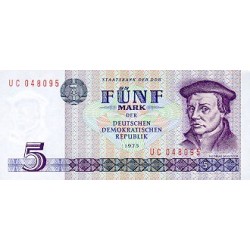
1975 - Germany D. Rep. Pic 27b 5 Marks banknote
Democratic Germany 5 Mark banknote associated with 1975, catalogued as Pick P27b. The note features ..
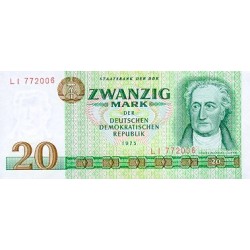
1975 - Germany D. Rep. Pic 29a 20 Marks banknote
This 20 Mark banknote from the German Democratic Republic is associated with 1975 and catalogued as ..
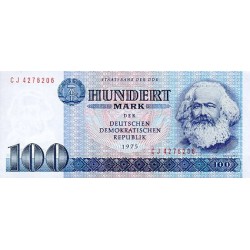
1975 - Germany D. Rep. Pic 31a 100 Marks banknote
This 100 Mark banknote from Germany’s Democratic Republic is associated with 1975 and is identified ..
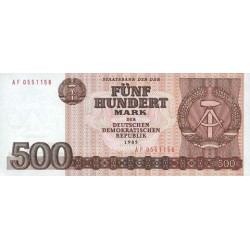
1985 - Germany D. Rep. Pic 33 500 Marks banknote
This Democratic Germany 500 Mark banknote is associated with 1985 and catalogued as Pick P33. The no..
Frequently asked questions
Which periods and denominations are represented in the Democratic Germany banknote catalog?
This shop’s Democratic Germany catalog includes banknotes dated from 1948 to 1985. The listed denominations range from 2 Marks to 500 Marks, including 5, 10, 20, 50 and 100 Marks. The earliest entries include 2, 20 and 50 Marks issues, while later entries include a 500 Marks note dated 1985. These selections describe the shop’s catalog and are not a complete list of every banknote issued by Democratic Germany.
Which Pick references can be found among these Democratic Germany banknotes?
The catalog identifies notes using Pick references such as P10b, P13b and P14b for the 1948 entries; P20a for 1955; and P26a and P26r for 1964. Later references include P27a, P27b, P28a, P28b, P29a, P30a, P31a and P33. Pick references provide a practical way to organise a collection and distinguish catalogued types or variants.
How can collectors distinguish similar Democratic Germany banknotes in this catalog?
Collectors can begin by comparing the year, denomination and Pick reference printed in the listing. This is especially important where the catalog includes related references, such as P27a and P27b for 5 Marks, P28a and P28b for 10 Marks, and P26a and P26r for 100 Marks. Comparing the note’s design and identifying details with the catalog images can provide an additional check, while the reference remains the clearest cataloguing aid.
What information should I record when identifying a banknote from this category?
For a Democratic Germany banknote, record its stated year, denomination and Pick reference, together with any visible design features that help compare it with the catalog listing. The supplied entries include examples from 1948, 1955, 1964, 1971, 1975 and 1985. For similar notes, note the complete suffix, such as “a,” “b” or “r,” because these references distinguish separate catalogued entries.
What should a prospective buyer check before ordering a banknote from this category?
Before ordering, check that the year, denomination and Pick reference in the listing match the note you want to add to your collection. The product records state that the images are for reference, so the banknote number visible in an image will not be sent. It is therefore sensible to use the image for design comparison while relying on the written title and reference for identification.
Which notable variant pattern appears in the Democratic Germany catalog?
A notable pattern is the presence of multiple lettered or coded variants within the same denomination and period. The 1975 5 Marks entries are listed as P27a and P27b, while the 1971 10 Marks entries are P28a and P28b. The 1964 100 Marks denomination also appears as P26a and P26r. This makes suffix comparison an important part of organising these catalogued notes.