
Chile

Our banknotes catalog of Chile
The peso is the currency of Chile. The current peso has circulated since 1975, with a previous version circulating between 1817 and 1960. The symbol used locally for it is $. The ISO 4217 code for the present peso is CLP. It is subdivided into 100 centavos, although no centavo denominated coins remain in circulation. The average exchange rate of the Chilean peso to the U.S dollar was 1 U.S. dollar to 594.17 Chilean pesos in November 2014.
Source: Wikipedia
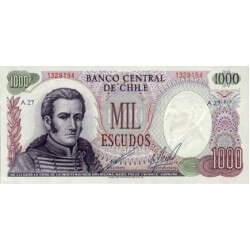
ND - Chile P146 1,000 escudos banknote
This Chilean 1,000 escudos banknote is catalogued as Pick P146 (ND). Its face uses purple and violet..
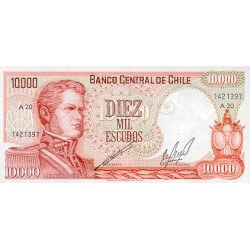
ND - Chile P148 10,000 Escudos banknote
This Chilean 10,000 Escudos banknote is catalogued as Pick P148 and listed as ND, with no specific d..
Frequently asked questions
What periods and currencies are represented in this Chile banknote category?
This shop’s Chile catalog represents peso and escudo-denominated material with dates shown from 1958/1959 through 2007, as well as several records listed as ND, meaning no date is stated in the title. The selection includes peso notes, cent-of-escudo denominations applied to peso values, and escudo notes. These records describe the range represented by the shop catalog rather than every banknote or monetary period associated with Chile.
Which Chilean denominations and Pick references appear in the catalog?
Represented denominations range from 5 pesos and fractional escudo values to 10,000 escudos. Examples include P119 at 5 pesos, P126b at 5 cents on 50 pesos, P127a at 10 cents of escudo on 100 pesos, P134A at 1/2 escudo, and P136 at 1 escudo. Higher denominations include P140b, P143, P146, P148 and P160a or P160b. The sequence is selective, not a complete run of Chilean Pick references.
How can I identify the Chile notes with values expressed in cents of escudo?
Look for both the new fractional escudo value and the underlying peso denomination in the catalog title. Chile P126b is identified as “5 cents on 50 pesos,” while P127a is listed as “10 cents of escudo on 100 pesos.” These combined denomination descriptions distinguish them from notes cataloged simply in pesos or escudos. When checking a note, compare the full denomination wording and Pick reference rather than relying on the first number alone.
What do suffixes such as “a” and “b” mean in the listed Pick references?
Letters form part of the complete catalog attribution and should be retained when identifying a note. This Chile category includes references such as P127a, P140b, P160a and P160b. The catalog also associates P160a with 2004 and P160b with 2007. Because the supplied records do not detail every design or technical difference behind these suffixes, buyers and collectors should use the full Pick reference and listed date to distinguish the cataloged variants.
What details should a buyer compare before choosing a Chile banknote?
Compare the denomination, currency, displayed date or ND designation, complete Pick reference, and any stated grade. For example, the catalog identifies P119 as a 1958/1959 5 pesos note and includes an XF designation, while a 1961 P126b listing is also explicitly marked XF. Condition should not be inferred when a title does not state it. A catalog record also does not by itself confirm purchasability, so consult the individual product page for ordering information.
Which repeated references or variant groups are especially useful for organizing this Chile category?
Two useful catalog patterns are P126b and the P160 variants. P126b is associated with the 1961 issue described as 5 cents on 50 pesos, including a record explicitly labeled XF. P160 appears with lettered references P160a and P160b, tied in the supplied titles to 2004 and 2007 respectively, both at 2,000 escudos. Grouping by the complete reference helps separate closely related records without assuming unlisted differences in signatures, printing or scarcity.