
Belarus

Belarus Banknotes
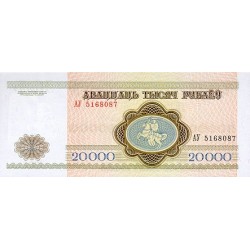
1994 - Belarus P13 20,000 Rublei Banknote
This Belarus 20,000 Rublei banknote is associated with 1994 and is catalogued as Pick P13. It featur..
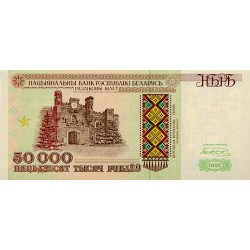
1995 - Belarus P14 50,000 Rublei Banknote
This individual Belarus banknote is catalogued as the 50,000 Rublei note associated with 1995, Pick ..
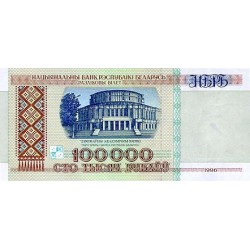
1996 - Belarus P15 100,000 Rublei Banknote
This Belarus 100,000 Rublei banknote is associated with 1996 and catalogued as Pick P15. The Krause ..
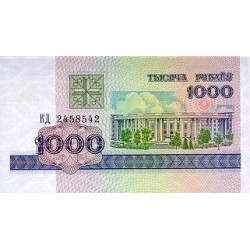
1998 - Belarus P16 1,000 Rublei Banknote
Belarus 1,000 Rublei banknote, catalogued as Pick P16, associated with 1998 and listed in the Krause..
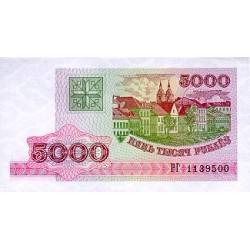
1998 - Belarus P17 5,000 Rublei Banknote
This individual Belarus banknote is the 5,000 Rublei denomination associated with 1998 and catalogue..
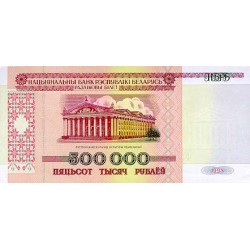
1998 - Belarus P18 500,000 Rublei Banknote
This Belarusian 500,000 Rublei banknote is associated with 1998 and is catalogued as Pick P18. The n..
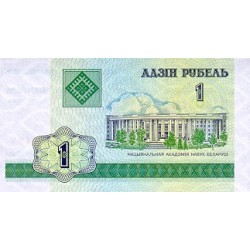
2000 - Belarus P21 1 Ruble Banknote
This Belarus 1 Ruble banknote is associated with 2000 and catalogued as Pick P21. Its design uses gr..
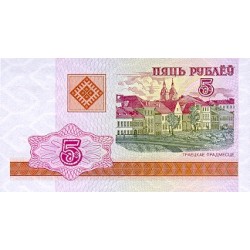
2000 - Belarus P22 5 Rublei Banknote
This Belarus 5 Rublei banknote is associated with the year 2000 and is catalogued as Pick P22. The n..
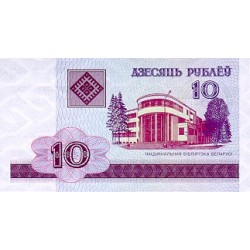
2000 - Belarus P23 10 Rublei Banknote
This Belarus banknote is the 10 Rublei denomination associated with 2000 and catalogued as Pick P23...
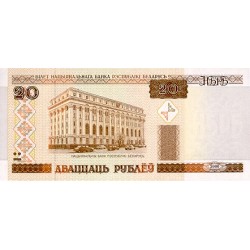
2000 - Belarus P24 20 Rublei Banknote
Belarus 20 Rublei banknote associated with 2000, catalogued as Pick P24. The note features a brown d..
Frequently asked questions
What periods of Belarus banknotes are represented in this shop’s catalog?
This Belarus category spans dated material from 1991 to 2009. The catalog includes notes dated 1991 and 1992, higher-denomination issues from 1994 through 1998, an extensive group dated 2000, and 10- and 20-rublei notes dated 2009. These dates describe the material represented by this shop’s records rather than a complete chronology of every banknote issued for Belarus.
Which denominations appear in the Belarus category?
The represented denominations range from 50 kopeken to 500,000 rublei. Early listings include 1, 3, 5, 10, 25, 50, 100 and 200 rublei, followed by denominations in the thousands and hundreds of thousands. The 2000-dated group includes values from 1 ruble upward, while the 2009 records include 10 and 20 rublei. This range reflects the shop’s catalog, not every Belarus denomination.
How can I identify a Belarus banknote using its Pick reference?
Match the note’s stated year and denomination with the Pick number shown in the catalog title. Examples include the 1992 50-kopeken P1, 1992 1-ruble P2, 1998 500,000-rublei P18 and 2009 10-rublei P38a. The suffix is part of the identification: P25a and P25b are separate catalog variants of the 2000 50-rublei note, so it should not be omitted when comparing records.
What is a practical way to organize the Belarus notes represented here?
Collectors can organize this Belarus material by date, denomination and catalog-reference sequence. One clear run begins with the 1992 P1 50-kopeken note and continues through P8, the 100-rublei denomination; the catalog also represents this P1–P8 range as a lot. Other useful groups include the 1994–1998 high-denomination notes and the 2000 P21–P31a sequence. Exact Pick suffixes should be retained when recording variants.
What should a buyer compare before choosing a Belarus banknote?
Compare the full catalog identification rather than relying on denomination alone. Check the listed year, denomination, Pick reference and any letter suffix. For example, the catalog contains both P25a and P25b for the 2000 50-rublei note, while 1,000- and 5,000-rublei denominations appear under references associated with different dates. A grouped P1–P8 lot is also distinct from individual listings. Consult the relevant product page for item-specific purchasing details.
Why do some Belarus references begin with “A” while others use standard P numbers?
The shop’s Belarus catalog includes both A-prefixed references and standard numbered Pick references. A-prefixed examples include A2a, A3a, A6a, A7a and A8a dated 1991, plus A10a, A20a and A26 dated 1992. Standard references include P1–P18, the 2000 P21–P31a group, and P38a–P39a dated 2009. Because the supplied records do not define the reference systems, identify each note by its complete code, date and denomination without treating the prefixes as interchangeable.