
Cuba

The peso (ISO 4217 code: CUP, sometimes called the "national peso" or in Spanish moneda nacional) is one of two official currencies in use in Cuba, the other being the convertible peso (ISO 4217 code: CUC, occasionally referred to as "dollar" in spoken language). The conversion between (CUC) and (MN) is $1(CUC)=$25(MN).
Cuban state workers receive a portion of their wages in convertible pesos, the rest in national pesos. Shops selling basics, like fruit and vegetables, generally accept only the normal peso, while "dollar shops" sell the rest.
The word "pesos" may refer to both non-convertible and convertible money. Cuban convertible pesos are 25 times more valuable, but this does not completely eliminate the confusion for tourists: since goods bought in national pesos have controlled prices, tourists are sometimes confused by prices perceived as "too cheap.
Source: Wikipedia
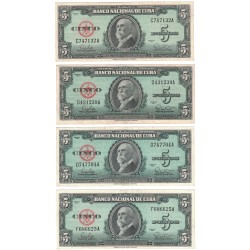
1960 - Cuba P92 5 Pesos banknote XF
Cuba 5 Pesos banknote associated with 1960, listed as Pick 92a and described in XF/EBC condition. Th..
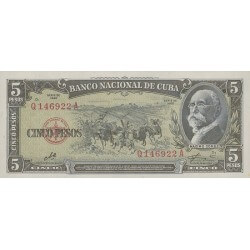
1960 - Cuba pick 91c 5 Pesos Banknote (Che Guevara signature)
This Cuba 5 Pesos banknote is associated with 1960 and catalogued as Cuba Pick 91c. Its front featur..
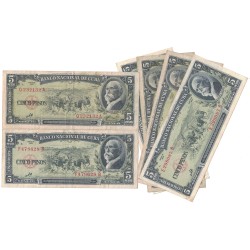
1960 - Cuba pick 91c 5 Pesos Banknote (Che Guevara signature) VF
This Cuba 5 Pesos banknote is associated with 1960 and identified as Pick 91c. The product title des..
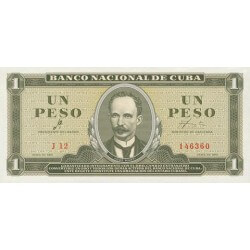
1965 - Cuba P94c 1 Peso banknote
This Cuban 1 Peso banknote is associated with the 1965 issue and is catalogued as Cuba Pick 94c. It ..
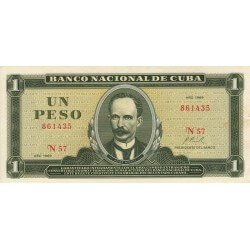
1967 - Cuba P102a 1 Peso banknote
This Cuban 1 Peso banknote is associated with 1967 and catalogued as Cuba Pick P102a. It belongs to ..
1968 - Cuba P102a 1 Peso banknote
This Cuban 1 Peso banknote is catalogued as Pick P102a and is associated with 1968. It belongs to th..
1969 - Cuba P102a 1 Peso banknote
This Cuban 1 Peso banknote is associated with 1969 and catalogued as Pick P102a. It belongs to varia..
1970 - Cuba P102a 1 Peso banknote
This Cuban 1 Peso banknote is catalogued as Cuba P102a, with 1970 associated with the 1967–1970 date..
1972 - Cuba P102a 1 Peso banknote
This individual Cuban 1 Peso banknote is associated with 1972 and catalogued as Cuba Pick P102a. It ..
1978 - Cuba P102b 1 Peso banknote
This Cuban 1 Peso banknote is catalogued as Pick P102b, the 1978–85 variety of the P102 design. The ..
Frequently asked questions
What periods and types of Cuban banknotes are represented in this shop’s catalog?
This Cuba category spans issues dated from 1896 through the 2020s. It includes regular notes from issuers such as Banco Español de la Isla de Cuba, Banco de Cuba, Banco Nacional de Cuba and Banco Central de Cuba. The catalog also represents commemorative issues, 1985 foreign-exchange notes and specimen notes marked “Especimen” or “Muestra.” These listings illustrate the scope of this shop’s catalog rather than every banknote issued for Cuba.
Which Cuban banknote denominations appear in the catalog?
The catalog includes Cuban notes denominated in centavos and pesos. Represented examples include 20 centavos and peso denominations of 1, 3, 5, 10, 20, 50 and 100. These occur across regular, commemorative, foreign-exchange and specimen issues. A denomination alone does not identify a note because the same value may appear in different years, designs and Pick varieties. Collectors should therefore compare the denomination with the issuer, date, design and catalog reference.
How can I distinguish closely related Cuban Pick varieties?
Start with the complete Pick reference and then verify visible details. For the 1896 10-peso design, P49c is described without an overprint, while P49d carries a red “PLATA” overprint on the back. The long-running 1-peso design appears under references including P102a, P102b, P102c and P102d, with catalog listings separated by variety and year. Other useful identifiers include serial-number color, issuer, printer, signature titles and specimen overprints.
How are Che Guevara-related Cuban notes identified in this catalog?
The catalog distinguishes notes bearing Che Guevara’s signature from notes featuring his portrait. Signature varieties include 1960 issues such as P80c in 20 pesos, P88c in 10 pesos, P91c in 5 pesos and P92 in 5 pesos; their descriptions identify his signature as bank president. Separately, P107b and commemorative P127a/P127b are 3-peso designs portraying Ernesto Che Guevara. Buyers should confirm whether a listing refers to a signature, portrait or both rather than relying only on the name.
What should I check before selecting a Cuban banknote from this category?
Check the Pick number, denomination, issue year, issuer, issue type and stated grade. Some designs occur in several varieties or years, and listings may distinguish conditions such as F, VF, XF or UNC. Also read the image note carefully: many catalog images are references, and the serial number shown may not be the one supplied, while some listings state that the pictured banknote corresponds to the item. These details help compare like-for-like Cuban notes without assuming that similar titles describe identical varieties.
What is distinctive about the Cuban foreign-exchange notes represented here?
The foreign-exchange group is identified by P-FX references and includes several denominations and lettered series. Many 1985 examples display the coat of arms of the National Bank of Cuba on the front, with a series letter in a circle. Described backs include engravings of Cuban fortifications, such as Castillo de San Salvador de La Punta, Castillo de los Tres Reyes del Morro, Castillo de Nuestra Señora de los Ángeles de Jagua and Castillo de La Real Fuerza. Other P-FX notes use simpler denomination-centered backs.